
A balance sheet is a fundamental financial statement that presents a company’s financial position at a specific point in time. Unlike the profit and loss statement, which measures performance over a period, the balance sheet provides a clear snapshot of a company’s assets, liabilities, and overall financial health on a given date. It is a key document used by investors, creditors, and tax authorities to evaluate a company’s net worth and long-term solvency.
In Odoo 19, the balance sheet is a dynamic, real-time financial report. Thanks to Odoo’s double-entry accounting system, every transaction recorded across modules such as Sales, Purchase, and Inventory is automatically reflected in the report. This ensures that users can continuously monitor financial health without waiting for manual month-end adjustments.
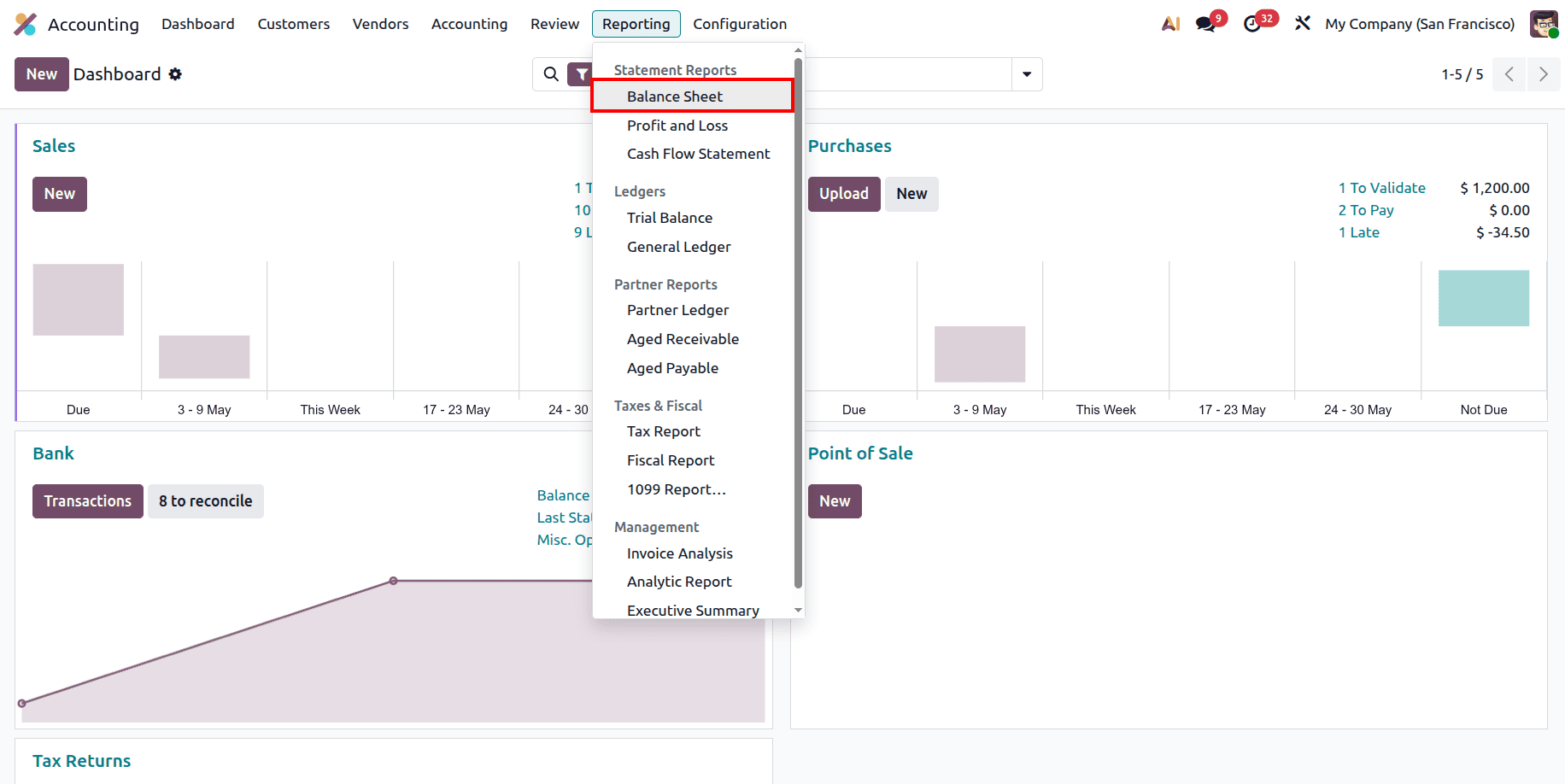
To access the balance sheet report, go to the Accounting module and open the Reporting menu. From there, navigate to the Statement Reports section and select Balance Sheet, as shown in the screenshot below.
The Fundamental Accounting Equation
Every balance sheet is built on a core financial principle: Assets = Liabilities + Equity.
This equation represents the foundation of accounting and ensures that a company’s financial records remain balanced at all times. It explains that everything a business owns (assets) has been financed either through borrowing (liabilities) or through the owner’s capital and retained earnings (equity).
In other words, every resource a company controls has a corresponding source of funding, making this equation essential for accurate financial reporting and analysis.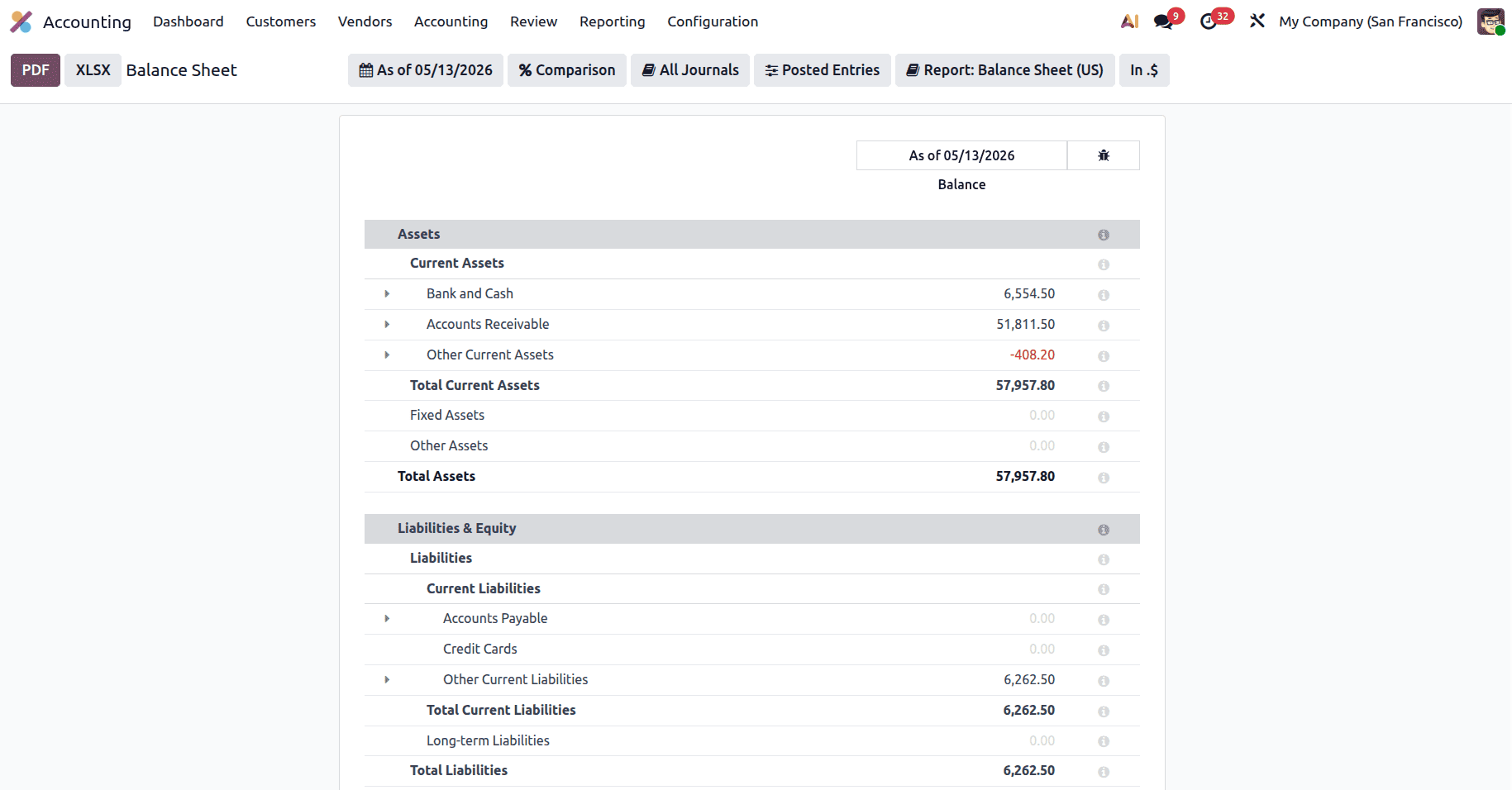
In Odoo, the balance sheet is designed so that both sides always remain in equilibrium. If any imbalance appears, it is typically caused by unposted journal entries or incorrectly configured accounts in the Chart of Accounts. Understanding this structure is an important step toward developing strong financial literacy and accurate accounting practices.
In general accounting, Odoo organizes financial data into three main categories, each further divided into sub-sections to help businesses clearly track assets, liabilities, and equity.
1. Assets (What You Own)
This section represents everything of value owned by the business. Odoo classifies assets based on liquidity, or how quickly they can be converted into cash.
- Current Assets:
These are short-term resources expected to be used or converted into cash within one year. They include cash, bank balances, inventory, and accounts receivable. Accounts receivable represents money owed by customers for goods or services already delivered, making it a key component of day-to-day cash flow management. - Fixed Assets:
These are long-term investments such as machinery, vehicles, property, and office equipment. They are not intended for immediate sale but are essential for business operations. - Other Assets:
This category includes items such as prepaid expenses (for example, insurance paid in advance) and security deposits that do not fall under standard classifications.
2. Liabilities (What You Owe)
Liabilities represent the financial obligations a business owes to external parties. In Odoo, these are also grouped based on their due timelines.
- Current Liabilities:
These are short-term obligations due within one year. They typically include accounts payable (amounts owed to suppliers), credit card balances, and other immediate financial commitments. - Other Current Liabilities:
This includes tax liabilities (such as VAT, GST, or TDS), accrued expenses, and short-term loans. - Long-term Liabilities:
These are financial obligations due beyond a 12-month period, such as long-term bank loans, mortgages, or equipment financing.
3. Equity (The Net Worth)
Equity represents the residual value of the business after all liabilities have been settled. It reflects the true net worth of the company and the owners’ stake in the business.
- Unallocated Earnings:
This refers to the current fiscal year’s profit or loss, which is automatically calculated by Odoo based on the Profit and Loss statement. - Retained Earnings:
These are accumulated profits from previous years that have been reinvested into the business rather than distributed to owners or shareholders.
Overall, Odoo’s structured financial reporting ensures transparency and consistency across all accounting records, making it easier to analyze financial health and maintain accurate books.
Detailed Analysis of Odoo 19 Filters
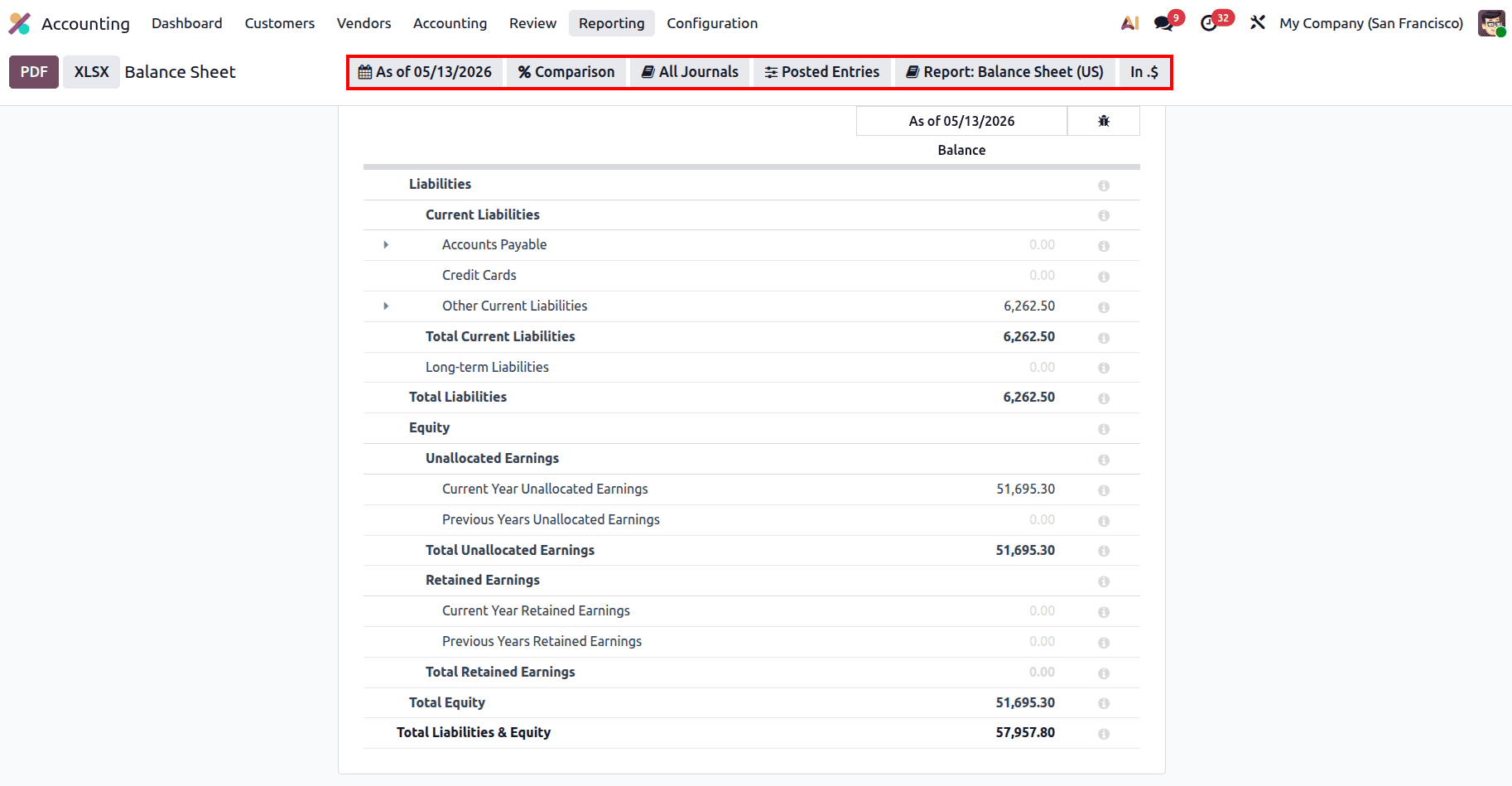
The power of Odoo 19 lies in its interactive filtering system, which transforms a standard financial report into a powerful analytical tool.
As of Date (Snapshot Control)
This filter defines the exact point in time for your financial snapshot.
- Today: Provides a real-time view of your accounts.
- End of Month / Quarter / Year: Essential for standard financial closing and reporting periods.
- Specific Date: Allows you to reconstruct the balance sheet as it appeared on any past date, enabling historical analysis and audits.
Comparison (Growth Tracking)
This option enables performance comparison across different periods. By selecting Previous Period or Same Period Last Year, businesses can identify financial trends such as changes in cash flow, asset growth, or increasing liabilities over time. This is especially useful for strategic planning and performance evaluation.
All Journals (Source Isolation)
By default, Odoo aggregates data from all accounting journals. However, this filter allows users to isolate specific journals such as Bank or Cash. This helps in analyzing individual financial sources without interference from other accounting entries.
Posted vs Draft Entries (Data Integrity)
This feature provides control over data accuracy and reporting scope. Selecting Draft Entries generates a pro-forma view of the balance sheet, including transactions that have not yet been validated.
Additional options include:
- Unfold All: Expands all account hierarchies for detailed review
- Hide Lines at 0: Removes accounts with zero balances for cleaner reporting
Currency Scaling (Numerical Display)
For organizations handling large volumes of transactions, currency scaling improves readability. Values can be displayed as:
- Raw amounts
- $ (rounded values)
- K$ (thousands)
- M$ (millions)
This ensures financial data is easier to interpret for executives and stakeholders.
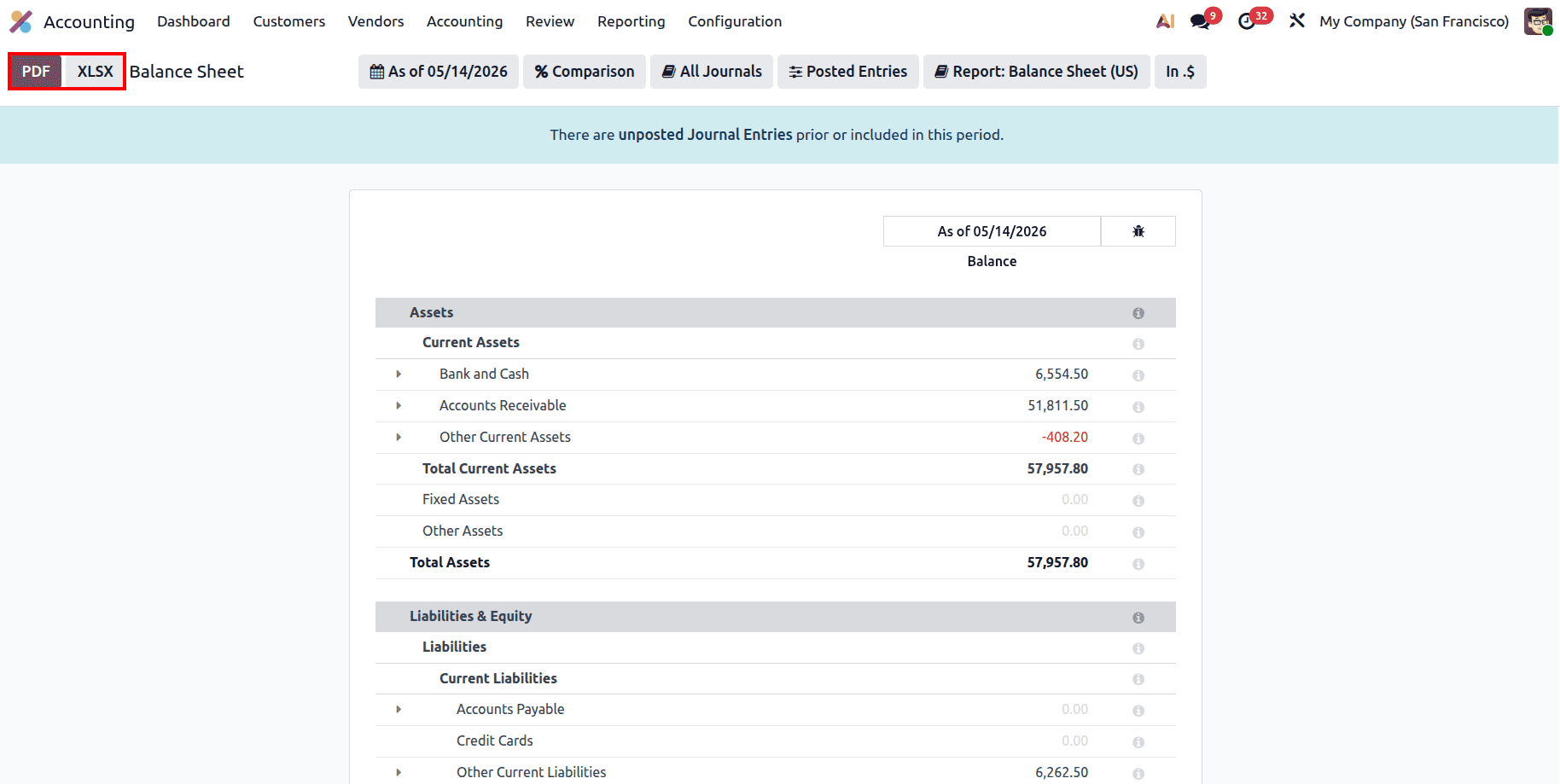
Data Integrity Warning
It is important to monitor the Unposted Journal Entries banner displayed at the top of the report. This warning indicates that some transactions—such as invoices or payments—have not yet been validated. Relying on reports with unposted entries may lead to incomplete analysis and inaccurate financial decisions.
Finally, the Balance Sheet in Odoo 19 can be easily exported or printed in PDF and XLSX formats, making it suitable for reporting, audits, and stakeholder presentations.
In conclusion, the Odoo 19 Balance Sheet serves as the ultimate record of a business’s financial health. By effectively using tools such as Comparison filters to track year-over-year growth and Currency Scaling for clear executive reporting, organizations can move beyond basic bookkeeping and embrace strategic financial management.
Regular reconciliation of Assets and Liabilities ensures that Equity accurately reflects the true value of the business. With consistent monitoring and analysis, businesses can make more informed decisions, maintain financial stability, and gain a clearer understanding of their long-term performance and growth.